Reversi rules
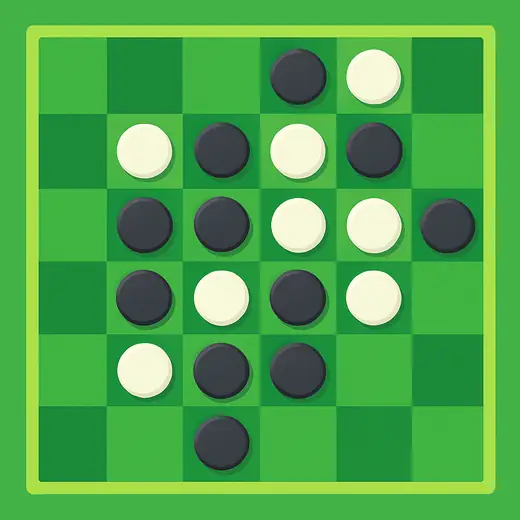
The full rules of Reversi (also sold as Othello), as played in tournaments and on PlayFaceToFace. The boards below are live positions, so you can watch each move place its disc and flip the line it traps.
The board and the starting position
Reversi is played on an 8×8 board with 64 discs. Each disc is black on one side and white on the other. Columns run a to h from left to right and rows run 1 to 8 from top to bottom, so every square has a name such as d3.
Four discs start in the centre on the diagonals. White sits on d4 and e5, Black on e4 and d5, so both players begin with the same position. Black always moves first, and then the players take turns.
What makes a move legal
On your turn you place one disc of your colour on an empty square. The move only counts if it traps at least one of your opponent's discs. A move is legal when all of these hold:
- The square is empty.
- Next to it, in a straight line, sits one or more of your opponent's discs in an unbroken row.
- That row ends with a disc of your own colour.
The line can run in any of eight directions: left, right, up, down, or along either diagonal. In the opening position, Black's d3 traps the white disc on d4 against the black disc on d5, so d4 turns black.
Flipping discs
Every opponent disc caught between the disc you place and another of your discs flips to your colour, straight away. A trapped line can be one disc long or run across most of the board, and a long row of white discs between two black ones flips as a whole.
One move often traps lines in several directions at once. All of them flip. You can't choose to flip one line and leave another, and you can't skip a flip you would rather not make.
Diagonals are the line beginners miss most often. Scan all eight directions from the square before you play, and before you judge what your opponent can do next.
Moves that are not allowed
A disc that flips nothing is an illegal move, however good the square looks. You have to pick another square. In the opening position, c3 touches the white discs on d4 and e5, but that diagonal ends on an empty square instead of a black disc.
The trapped line also has to be continuous. You can't jump over an empty square, and the line must be straight: a row, a column or a true diagonal, never a bend.
Passing
If you have no legal move, you pass and your opponent moves again. Passing is forced. You can't pass while a legal move exists, even one you dislike. Play returns to you as soon as one of your moves becomes legal again.
Passes matter more than they look. A player who runs out of moves hands the opponent extra turns, which can decide who gets a corner or an edge.
How the game ends and who wins
The game ends when neither player has a legal move. That usually means all 64 squares are full, but it can happen with empty squares left. Each player then counts the discs showing their colour, and the higher count wins. Equal counts are a draw. There is no other scoring.
Corners, edges and X-squares
These are not rules, but they follow straight from them. A corner (a1, h1, a8, h8) can never be flipped, because no line can run past it. Edges are harder to flip than inner squares since fewer lines cross them, and they shape how many moves each side has later in the game.
The X-squares b2, g2, b7 and g7 sit diagonally next to the corners. Taking one early tends to give your opponent a line into the corner. A disc that can never be flipped again is called stable. Stable discs grow out from corners along filled edges and complete rows, and they decide the final score.
Strong players care more about mobility, the number of legal moves they have, than about disc count. Leave your opponent with few moves and they may have to give up a corner or pass. Near the end, experts also count whether the empty regions hold an odd or even number of squares, so they get the last move in each. The beginner strategy guide covers these ideas in more depth.
Try a quick demo game
A private solo board against the AI, right here on the page. Nothing to sign up for.
Reversi

You know the rules. Sit down at a board.
Private rooms with friends and optional video chat, or a practice game against the AI. No download, no sign-up.
Keep reading
Spotted a mistake or have a question? Send feedback