Reversi advanced strategy: mobility, corners, edges and parity
Once you avoid X-squares and protect your corners, the next step is the thinking behind strong Reversi play. This guide covers potential mobility, forcing corners, C-squares, edge wedges, stability, parity and tempo, with live positions checked by the game engine.
Mobility and potential mobility
Mobility is the number of legal moves a player has, and at a higher level it is the main thing you manage. Strong players track two kinds. Current mobility is the moves you have right now. Potential mobility is the moves you are likely to get soon, which depends on how many of your opponent's discs sit next to empty squares.
Discs that touch an empty square are called frontier discs. Every one of your frontier discs is something your opponent may be able to play against. Keep your frontier small and your opponent's large, and the move counts tend to follow.
With plenty of moves you choose among safe ones and push your opponent toward weak squares. Short of moves, you get pushed onto edges and X-squares and end up handing over corners. Think of mobility as the air your position breathes. The aim of a good move is to keep your own options while taking away your opponent's.
Corners, and how to force one
A corner can never be flipped. It anchors the edges next to it, lets stable discs spread along them, and gives you a lot of say over that quarter of the board for the rest of the game.
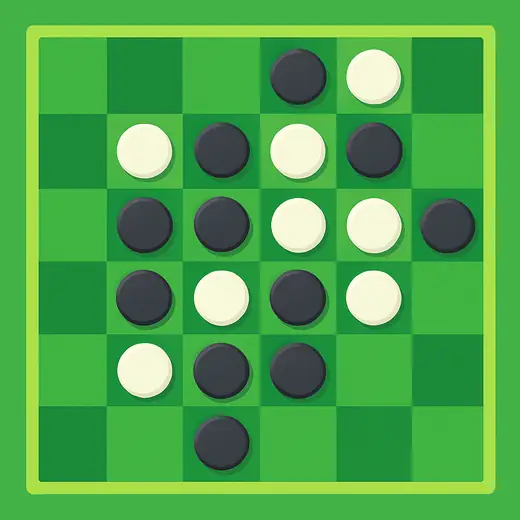
The advanced idea is to make your opponent give you a corner. That happens when their mobility collapses and the only moves left are X-squares, C-squares or other squares that open a corner for you. In the position below Black has more discs, but Black has run out of safe moves.
Strong players sometimes look weak on purpose. They let you collect edge discs if doing so drains your mobility, then wait until your only moves give them a corner.
X-squares, C-squares and corner regions
The X-squares b2, g2, b7 and g7 sit diagonally next to the corners. Early on they are very dangerous, because they give your opponent a direct line into the corner. Avoid them unless the corner next to them is already taken or can't be reached.
The C-squares are the edge squares right next to a corner: a2, b1, g1, h2, a7, b8, g8 and h7. They are also risky early. Your opponent can slip in between your C-square and the corner, and they often start the sequence that loses the corner. A C-square can be safe, but only once you have read the edge around it carefully.
It helps to think of each corner as owning the 3×3 block around it. Before a move, ask what it does to each of those four regions.
When edges help and when they hurt
Edges look strong and often aren't. Taken early, an edge usually costs you mobility, makes your next moves easy to predict, lets your opponent control how the edge fills up, and can open the way to a corner. Beginners take them too soon because they misjudge that risk.
Late in the game an edge can win it. Edges get strong once the corner next to them is secure, stability is spreading from that corner, your opponent is short of moves, and you control the last move in the edge region. They matter a lot in the final count because they often turn into long rows of stable discs.
That move is a wedge, a disc dropped into a gap in an opponent's edge, where the opponent has no way to flip it back along that edge. Experienced players learn edge patterns like this one, and the sequences that break an edge open, so they can tell when an edge is safe to take and when to leave it.
Stability
A stable disc can never be flipped again. Stability starts at the corners, runs along the edges joined to them, and fills in between. Rows and columns that are completely full can't be flipped along their length either, and in the endgame whole regions lock up once they close.
Beginners count all their discs. Advanced players sort them into three groups: stable discs, discs that are likely to become stable, and discs that will stay exposed. A player with fewer discs but more of them on their way to stability often wins.
Parity
Parity is about who gets the last move in each empty region of the board. Whoever moves last in a region usually picks up stable discs there, decides how the region's discs end up, and can sometimes leave the other player with nothing to do but pass. Late in the game that decides a lot of games.
If nobody passes, players take turns inside a region. So in a region with an odd number of empty squares, the player who moves there first also moves there last. The usual advice is to play into odd regions and avoid opening even ones. Across the whole board, 60 squares start empty, so without any passes White makes the last move of the game. Black needs a pass somewhere to win parity back.
In that position h7 is a region of one square, and White could also play there. Black takes it first. In the best line after that, White plays h2, the pairs on the left fill up, and White runs out of moves twice, so Black makes the last two moves of the game. Strong players split the late board into regions like these (the left side, the right side, each corner) and treat each one as its own small battle. Some of them can be counted out exactly.
Tempo, passes and keeping your disc count low
Tempo is about controlling who moves next. Leave your opponent with no legal move and they have to pass, which gives you two moves in a row. A forced pass often swings the game. You get there by cutting your opponent's mobility on purpose, holding back from filling certain squares too soon, playing quiet moves that limit their options, and keeping your disc count low early on.
Keeping your own disc count low through the opening and middle game is the paradox that confuses newer players most. Fewer discs usually means more moves for you, fewer frontier discs for your opponent to play against, and more freedom to choose what to flip later. What counts is how many discs are yours and stable at the end, not how many you flipped along the way.
Opening, middle game and endgame
Reversi openings are not fixed the way chess openings are, but patterns matter. Good early moves flip few discs, keep a presence in the centre, don't give your opponent an edge, and keep your options open. Bad early moves take edges, play into X-squares, build long stable lines too soon, or give your opponent a way into a corner.
The middle game is where Reversi gets explosive. Before each move, ask how many moves it gives your opponent and how many it costs you. Decisions here often settle who can reach which corner later. Watch for hot squares, such as edge squares or squares next to a corner, that are about to become very valuable, and don't be the one who makes them available. Look for moves that force a chain of replies ending in a corner for you.
Most games are decided in the endgame. Strong players count it out, tallying stable discs, unstable discs, what each move would flip, and who will move last in each region. Win the parity battles and you usually win the game.
How strong players weigh a move
Before playing, a strong player runs through questions like these:
- Does this improve my mobility?
- Does it reduce my opponent's mobility?
- What does it do to the corners and their stability?
- Does it change who gets the last move in a region?
- Does it set up a trap, or walk into one?
- Does it expose me to an X-square or a dangerous edge?
- Will it force a pass later?
A move that fails several of these questions is probably a mistake, however good it looks.
| Concept | Meaning | Why it matters |
|---|---|---|
| Mobility | Your number of legal moves | Controls the flow of the game |
| Potential mobility | Moves you are likely to get soon | Lets you plan ahead |
| Corners | Squares that can never be flipped | The most valuable squares on the board |
| X-squares | Squares diagonal to a corner | Dangerous while the corner is open |
| Edges | Stable late, risky early | Timing decides whether they help |
| Stability | Discs that can never be flipped | They decide the final score |
| Parity | Who moves last in each region | Often decides the endgame |
| Few discs early | Keeping your disc count low | Keeps your mobility high |
| Tempo | Forcing your opponent into bad moves or passes | Builds winning sequences |
If some of this felt too far ahead, the beginner strategy guide covers the basics these ideas build on.
Try a quick demo game
A private solo board against the AI, right here on the page. Nothing to sign up for.
Reversi

Test your parity counting on a real board.
Private rooms with friends and optional video chat, or a practice game against the AI. No download, no sign-up.
Keep reading
Spotted a mistake or have a question? Send feedback