Common Reversi mistakes and how to avoid them
Reversi looks like a game of flipping discs, but it is really about mobility, well-timed sacrifices and planning ahead. These are the traps new and intermediate players fall into most often, with live positions checked by the game engine and a fix for each.
Taking too many discs too early
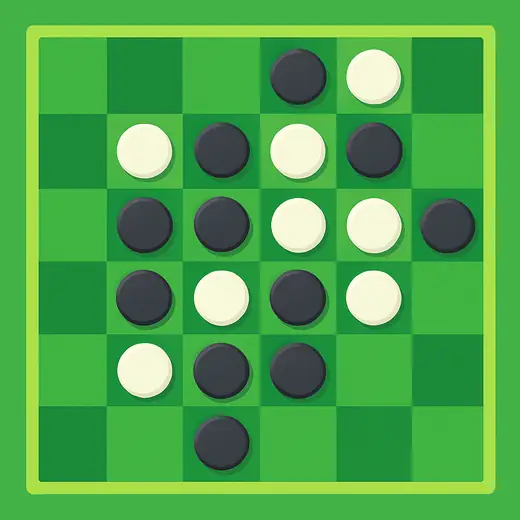
The most common beginner mistake is flipping as many discs as possible every turn. Taking lots of discs early cuts your own mobility, gives your opponent more moves to choose from, makes it easier for them to force you to pass, and leaves you with loose discs they can flip straight back. In Reversi, a big disc lead early on often turns into a loss later.
From the same position, the quiet c5 flips only d5 and leaves White with 8 moves and Black with 10. The fix is to choose quiet moves that flip few discs, especially in roughly the first 20 moves.
Playing X-squares and C-squares too early
X-squares (b2, g2, b7 and g7) sit diagonally next to the corners. A disc there often lets your opponent take the corner, which gives them stable discs and leaves you with a lasting disadvantage. Beginners play into them because they see an easy flip. Those flips are usually a trap.
C-squares are the edge squares right next to a corner: a2, b1, g1, h2, a7, b8, g8 and h7. Played too early, they let your opponent wedge into the corner, weaken your edge, and start sequences that end with the corner in their hands.
Leave X-squares alone unless the corner next to them is already settled, it is late in the game, or you have counted out a clear parity or flipping gain. The same goes for C-squares. Play one when the corner is already stable, when you have read a forced sequence that works for you, or when you are deliberately playing for parity.
Taking edges too early, or in the wrong order
Edges look stable, so they look strong. Early edge moves often backfire. They reduce your mobility, give your opponent patterns they can play against, and can open the way to the C-squares and the corner. Edge moves are usually better left until the middle or late game, unless one is clearly safe. Take an edge when the corner is safe, you have more moves than your opponent, and the edge discs will soon be stable.
The order matters too. Beginners often fill an edge from the middle outward, which leaves discs that can still be flipped and gaps your opponent can cut into. Build edges outward from a corner you already hold, only when the discs will stay put, and keep an eye on parity in the regions next to them.
Even once the corners are settled, edges need care. Rushing to take them, building long unstable snakes of discs, opening weaknesses behind them in the interior, and misjudging how they change parity are all common. An edge is strong when part of it is already stable, when it connects to a corner, and when it helps you win the last move in its region.
Handing your opponent moves
A move that opens lots of new squares for your opponent is usually a bad one. With more moves, they control the middle game, they can steer you into positions where you lose a corner, and they can keep you away from edges and corner regions. Big flips are the usual culprit. A move that gains many discs but leaves you with fewer moves is almost always wrong, because mobility outweighs a temporary disc lead.
This happens because the gain is visible and the cost isn't. Before you move, count how many moves you will have afterwards and how many your opponent will have, and check whether the move pushes you toward risky squares near an edge. If it opens new diagonals for your opponent, think again.
Read your opponent's moves the same way. A flip that looks aggressive is often about mobility. Ask what options their move gained them, whether they are setting up a corner, and how their move count changed. Players who start asking those questions are on their way to intermediate level.
Judging the game by disc count
Beginners often decide who is winning by who has more discs. In the middle game that is misleading. Discs can be flipped back, a high count usually means fewer moves, central discs stay unstable for a long time, and the final score depends on what is stable at the end.
Track mobility, corner access, how many discs could become stable, and parity instead. Disc count mostly matters in the last stretch of the game.
A related mistake is chasing stable discs too early. Spending moves to lock down stability early restricts your mobility, gives your opponent predictable patterns, closes off regions before you are ready, and makes the rest of the board easier for them to control. A corner that falls into your lap early is still worth taking. Just don't give up mobility to chase stability before the endgame.
Giving away corners
Corners are the most valuable squares in Reversi, and most lost corners come from a handful of habits:
- Playing X-squares.
- Taking edges early.
- Flipping so many discs that you open a diagonal to a corner.
- Not noticing your mobility running out.
- Leaving your opponent's routes into the corner open.
Prefer moves that reduce your opponent's mobility over moves that flip many discs, and before each move check whether it opens a line into a corner.
Ignoring parity and passes
Parity is about who moves last in each empty region, and the player who does usually wins that region. Common mistakes are opening regions with an even number of empty squares, which tends to hand your opponent the last move there, ignoring how the empty squares split between the left and right sides, letting your opponent decide when regions close, and losing track of passes late in the game.
You can start simply. Try to make sure you get the last move in each region. Even a rough feel for parity is worth a lot, and the advanced strategy guide shows it on a real endgame.
Forcing your opponent to pass is almost always good, since you get two moves in a row. Two moves in a row also changes who moves last in each region, so count the regions again afterwards. And don't strain for a pass if the only move that forces it gives away an edge, a corner or a lot of stable discs.
Missing diagonals
New players miss diagonal flips and diagonal threats all the time. They misjudge which diagonal discs are safe, miss diagonal routes into a corner, and overlook long diagonals that will matter later.
The fix is a habit. Check all eight directions from a square before you play there, and again before you decide what your opponent can do next.
The mistakes at a glance
| Mistake | Why it hurts | How to fix it |
|---|---|---|
| Taking too many discs early | Cuts your mobility | Choose quiet moves |
| Playing X-squares early | Gives away corners | Wait until the corner is settled |
| Taking edges early | Leaves you less flexible | Delay edge play |
| Flipping too much | Gives your opponent more moves | Limit flips on purpose |
| Ignoring parity | Loses endgame regions | Plan to get the last move |
| Opening lines to corners | Hands over stable discs | Check diagonals and edges first |
| Watching disc count | Misreads the position | Count discs only in the endgame |
Cutting out these mistakes is one of the quickest ways to improve. If you want the ideas behind them laid out from the start, read the beginner strategy guide.
Try a quick demo game
A private solo board against the AI, right here on the page. Nothing to sign up for.
Reversi

See which mistakes you still make.
Private rooms with friends and optional video chat, or a practice game against the AI. No download, no sign-up.
Keep reading
Spotted a mistake or have a question? Send feedback