Reversi FAQ
Straight answers to the questions new and intermediate players ask most about Reversi (also sold as Othello), from how a move works to corners, parity and how long a game takes.
The basic mechanics fit in a sentence. You place discs, flip discs and try to control the board. Players still have plenty of questions about the rules, the tactics and the differences between versions, whether they learn on PlayFaceToFace or at a table. For the complete rules with board examples, see Reversi rules.
Rules and moves
What is the objective of Reversi?
Finish with more discs of your colour on the board than your opponent. The count happens when the board is full or when neither player has a legal move. There are no points along the way, only the final count.
How does a player make a legal move?
The square must be empty, your disc must flank at least one continuous line of your opponent's discs, and that line must end with one of your own discs. Every flanked disc flips straight away. A move that flips nothing is illegal.
What directions can I flip discs in?
Eight: left, right, up, down and the four diagonals. A flanking line has to be continuous, so an empty square anywhere in it breaks it.
Who moves first in Reversi?
Black. That holds in the official rules and on online platforms, PlayFaceToFace included.
Can I place a disc anywhere on the board?
No. You can only place a disc where it traps and flips at least one line. An empty square that flips nothing is not a legal move.
Passing and the end of the game
What happens if I have no legal move?
You pass, and your opponent moves again. Passing is mandatory when you have no move, and you can't skip a turn while a legal move exists. On PlayFaceToFace the pass happens automatically. If neither player can move, the game ends.
How does the game end?
It ends when neither player has a legal move, which includes a full board. Both players count their discs and the one with more wins.
Can a game end in a tie?
Yes. If both players finish with the same number of discs, for example 32 each on a full board, the game is a draw. Ties are rare but they happen.
Disc count and mobility
Do disc counts matter before the end of the game?
Not really. Early and midgame counts mislead, because discs flip back easily, a high count cuts your mobility, and early gains often turn into late problems. The count only means something in the final phase.
What are "mobility" and "potential mobility"?
Mobility is the number of legal moves you have right now. Potential mobility looks ahead to the moves you are likely to get later, the ones your opponent's moves will open up for you. Mobility is the most important strategic factor in Reversi. It decides who controls the flow of the game, shapes who gets the corners and predicts when someone will be forced to pass. Having more moves is almost always better.
What is a "quiet move"?
A move that flips only a few discs, often just one. Quiet moves keep your mobility up, limit your opponent's options and avoid handing them big chances. Advanced players rely on them heavily.
What is a "loud move"?
A move that flips many discs at once. Beginners like them, but they usually hurt. They cut your mobility, open new lines for your opponent and expose edges and corners. Outside the endgame, loud moves are generally weak.
Why is it good to have fewer discs early in the game?
Fewer discs mean more mobility and less exposure to flips. You keep more flexibility for the endgame and more say in how the edges take shape. Keeping your disc count low is a core principle among strong players.
Corners, edges and risky squares
Why are corners so important?
The corners a1, h1, a8 and h8 can't be flipped once taken. They stabilise whole edges, start chains of stable discs and sharply limit your opponent's options. Losing a corner often decides the game.
What are X-squares and why should I avoid them?
X-squares sit diagonally next to the corners, on b2, g2, b7 and g7. Playing one early often gives your opponent a direct route into the corner, control of a stable edge and a lasting advantage. Avoid them unless the corner is already safe or the game is nearly over.
What are C-squares and why are they risky?
C-squares are the edge squares right next to a corner: a2, b1, g1, h2, a7, b8, g8 and h7. Played too early, they invite wedge moves from your opponent, leave the corner vulnerable and cut your mobility. Use them for a reason, not by habit.
Are edges good or bad?
Strong late, bad early. Early edges cost mobility, are easy to destabilise, lead to lost corners and lock you into predictable patterns. Late in the game, edges give stability, link up corner chains and affect endgame parity. When you take an edge matters more than the edge itself.
Endgame ideas
What is parity in Reversi?
Parity is about getting the last move in a region. In a region with an odd number of empty squares you want to move last. In one with an even number you want your opponent to move last. Controlling parity often wins the endgame.
Why do advanced players divide the board into "regions"?
Endgames are often won region by region. Thinking in regions helps you apply parity, see forced sequences coming, judge mobility in each area on its own and plan chains of stable discs. It is an advanced skill.
Why do games sometimes end with huge flips?
Late in the game, stability forms suddenly, whole edges join up, players run out of safe squares and the walls between regions collapse. Big flips at the end are normal and often expected.
What is a stable disc?
A disc that can't be flipped for the rest of the game. Stability comes from corners, filled edges joined to corners, completely filled rows or columns, and regions that have been sealed off. Stable discs usually decide the final score.
Why does my opponent sometimes force me into bad moves?
Usually because they have more moves than you, they are working the parity, your position is boxed in, they control the way into the corners, or your edges are unstable. A lot of Reversi is about creating weaknesses for your opponent by squeezing their mobility.
Learning and playing
What Reversi mistakes should I avoid?
The usual ones are taking too many discs early, playing into X-squares, taking edges too soon, trusting the disc count, ignoring mobility, giving away corners and getting parity wrong. Once you can spot them, you improve quickly.
Where can I practice Reversi online?
PlayFaceToFace has real-time Reversi with friends, optional video chat so you can see each other, smooth flip animations and full rules enforcement, and games start quickly. It works for beginners and strong players alike.
How long does a Reversi game typically last?
A casual game usually takes 5 to 10 minutes, and a competitive one 10 to 20. Games are short enough that you can practise a lot in one sitting.
Mobility, corners, edges, stability and parity cover most of what separates good players from new ones. The common mistakes guide shows the traps in more detail.
Try a quick demo game
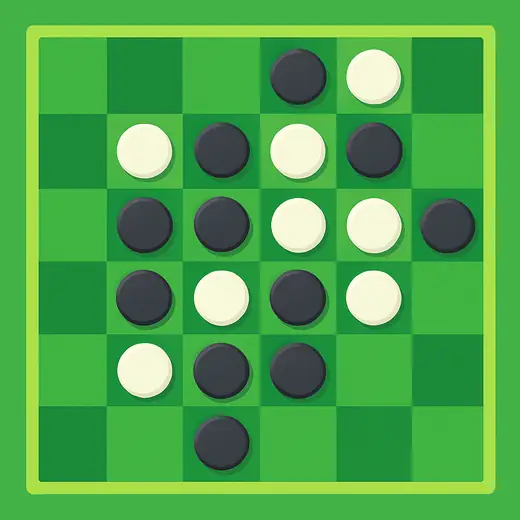
A private solo board against the AI, right here on the page. Nothing to sign up for.
Reversi

Questions answered. Sit down at a board.
Private rooms with friends and optional video chat, or a practice game against the AI. No download, no sign-up.
Keep reading
Spotted a mistake or have a question? Send feedback