Reversi beginner strategy: the core ideas new players need
Most new players try to flip as many discs as they can every turn, and most of them lose that way. This guide covers what wins instead: mobility, corners, careful edge play, quiet moves and stable discs. The boards are live positions checked by the game engine.
Mobility matters more than discs
Mobility is the number of legal moves you have on your turn. It is the first thing to learn and the idea most beginners never hear about. With plenty of moves you set the pace, you have room to pick a safe one, and you can make quiet moves that leave your opponent nothing good in reply.
A player who runs short of moves becomes predictable. Sooner or later every option left is a bad one, and that is usually how corners and edges get given away.
Why corners are worth so much
The corners a1, h1, a8 and h8 are the strongest squares on the board. A disc in a corner can never be flipped, because no line runs past it. It anchors the edges next to it, and edge discs joined to it in an unbroken row become impossible to flip as well.
One corner can swing a whole game. So don't give a corner away unless you have no other move, and don't play a square that hands your opponent an easy route into one. Strong players very occasionally give up a corner on purpose for something bigger, but that is a judgement for later.
Stay off the X-squares
The X-squares are b2, g2, b7 and g7, diagonally next to each corner. A disc there often gives your opponent a direct line into the corner. Once they take it, the damage is permanent: they gain stable discs, and you have opened the corner region for them.
X-squares are one of the most common beginner traps, because they often flip a few discs and look harmless. Late in the game things change. Once the corner next to an X-square is taken or nobody can reach it, the X-square stops being dangerous.
Edges are risky early and strong late
Edge discs are harder to flip than inner ones, so edges look strong. Taken too early they cost you. They tend to reduce your mobility, give your opponent obvious replies, and leave gaps that lead to a corner.
Take an edge when it does a job. Good times are when you already hold the nearby corner or your opponent can't reach it, when the edge discs will become stable, and late in the game when mobility counts for less and the final count counts for more.
Quiet moves and loud moves
A quiet move flips very few discs. A loud move flips many. Loud moves look powerful, which is exactly why beginners like them, but they usually cut your own mobility and open new squares for your opponent. Quiet moves keep your options open and leave your opponent fewer good replies, so they tend to be stronger in the opening and middle game.
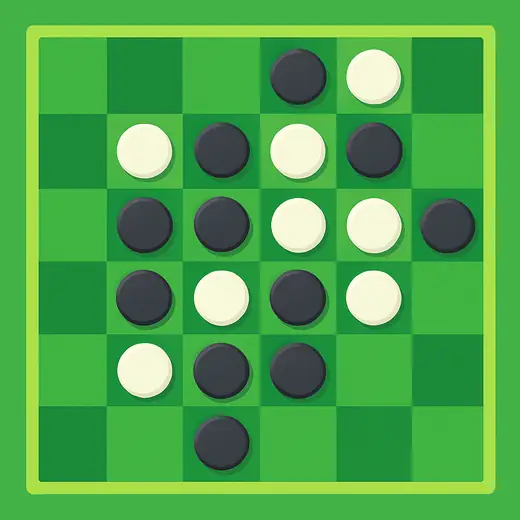
Here is the same position twice, with Black to move. Black's f2 flips four discs. Black's c4 flips one.
This leads to an idea that surprises most new players. Early in the game, having fewer discs is often an advantage. Fewer discs means more moves for you, fewer targets for your opponent, and less chance of a big section being flipped back in one go. It feels backwards at first, but it is one of the fastest ways to improve.
Stable discs
A stable disc is one that can never be flipped again. Stable discs usually form in corners, along edges joined to a corner, and in rows or columns that fill up late in the game. They lock down regions of the board, limit how your opponent can move, and decide the final count.
Beginners tend to watch the disc count in the middle of the game. Stable discs are a much better guide to who is ahead, because a big pile of unstable discs can change colour in a few moves.
A plan for each stage of the game
The opening, roughly the first 15 to 20 moves, sets up the structure of the middle game. In it:
- Stay off the edges. They restrict your options too soon.
- Avoid the X-squares, so you don't hand over a corner.
- Prefer moves that flip few discs.
- Play in the central 4×4 area where you can. Moves there are usually safer.
- Look for moves that leave your opponent fewer options.
The middle game is where things get messy. Count both sides' moves regularly and try to keep yours high and theirs low. Plan ahead for the fights over corners by making them hard for your opponent to reach, and watch how the edges are forming, since edges often decide those fights. One move can flip a lot of discs, so before you play, check whether you are setting up a big swing for your opponent.
The endgame, roughly the last 10 to 15 moves, is when the disc count starts to matter. Look for stable discs on corners and edges, and think several moves ahead, because the empty squares left are few and tightly constrained. If you can leave your opponent with no legal move, they pass and you move again, which is a big advantage. Try also to get the last move in each empty region of the board. That idea is called parity, and the advanced strategy guide explains it.
Beginner mistakes and how to improve
These five mistakes cost new players the most games:
- Taking too many discs early, which uses up your mobility.
- Taking edges too soon, which leaves you less flexible.
- Playing X-squares, which often gives your opponent a corner.
- Ignoring your opponent's mobility. Games are won on choices and control far more than on disc count.
- Chasing the biggest flip. The biggest flips are often the worst moves.
To get better fast, practise quiet moves until they feel natural, and play lots of short games, since Reversi rewards repetition. After a loss, go back over the game and ask where you lost mobility, whether you gave away a corner, and whether you played into an X-square. It also helps to learn a few common openings. They are not as fixed as chess openings, but recurring patterns do exist.
| Concept | In short |
|---|---|
| Mobility | Keep your number of legal moves high |
| Corners | Don't give them away unless you have no choice |
| X-squares | Avoid them early, while the corner next to them is still open |
| Edges | Weak early, strong late |
| Quiet moves | Usually better than big flips |
| Fewer discs early | More moves for you, fewer targets for your opponent |
| Stable discs | They decide the endgame |
Once these feel natural, the advanced strategy guide takes them further, and the common mistakes guide covers the traps that still catch intermediate players.
Try a quick demo game
A private solo board against the AI, right here on the page. Nothing to sign up for.
Reversi

Put the ideas to work on a real board.
Private rooms with friends and optional video chat, or a practice game against the AI. No download, no sign-up.
Keep reading
Spotted a mistake or have a question? Send feedback