The American Mahjong Card Explained
What the yearly American mahjong card is, how to read its colors, letters and values, and how players use it at the table. No card hands are reproduced here.
What is the American mahjong card?
In American mahjong you can only win with a hand that is printed on the card. The card is a folded sheet, published by the National Mah Jongg League, that lists every winning hand for the year. Each player keeps a copy in front of them during play.
The League was founded in New York in 1937 and still sets the standard rules for American mahjong. People often search for it as the "National Mahjong League", but its own spelling is National Mah Jongg League. This page is an independent guide written by PlayFaceToFace.
A new card every year
The League issues a new card every year, usually in the spring around April. Many hands change from one year to the next, and some sections are rebuilt completely. Once a new card comes out, tables switch to it and the old one is retired.
The mahjong card for 2026 is the one in play now, and it stays current until the League releases the 2027 card. The yearly change is a big part of the game's appeal. Even experienced players have to relearn which hands are worth chasing.
The hands are grouped into sections by theme. Typical themes include even numbers, odd numbers, consecutive numbers, matching numbers across suits, winds and dragons, and hands built from the digits of the year. The sections and the hands inside them change from card to card.
How to read the card
Each line on the card is one hand, written as 14 tiles in a short code of numbers and letters. A run of identical symbols is a group, so four of the same letter means a kong of that tile. Colors and notes in parentheses tell you which suits you can use.
| On the card | What it means |
|---|---|
| 1 to 9 | A suit tile of that number |
| F | A flower. All eight flowers count as the same tile |
| D | A dragon, usually the one that matches the suit shown in the same color |
| N, E, W, S | North, East, West and South winds |
| 0 | The white dragon (Soap) used as a zero in year hands |
| Colors | One color is one suit. Two colors means two different suits, three colors means all three |
| Notes in parentheses | Extra conditions, such as which suits or numbers you may choose |
| X or C | Whether the hand may be exposed (X) or must stay concealed (C) |
| Number at the end | The value of the hand, used for payments |
The colors on the card do not stand for fixed suits. A hand printed in one color can be made in bams, craks or dots, as long as all those tiles share a suit. Where a dragon is printed in a suit's color, it is the dragon that goes with that suit.
| Suit | Matching dragon |
|---|---|
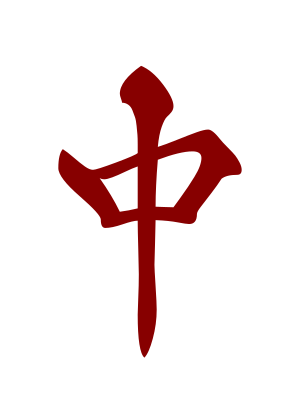
| Craks (characters) | Red dragon |
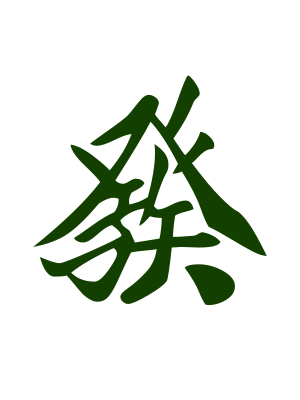
| Bams (bamboo) | Green dragon |
| Dots | White dragon (Soap) |
Exposed and concealed hands
A hand marked X can be built with discards you call from other players. When you call a discard you expose that group face up on your rack, and everyone at the table can see part of what you are making.
A hand marked C must stay concealed. You build it from tiles you draw yourself, and the only discard you can take is the last tile for Mah Jongg. Concealed hands often carry a higher value because they are harder to finish.
What the values mean
The number printed at the end of each line is what the hand pays. Harder hands are worth more. The winner collects that value from the other players, doubled in some cases.
| Situation | Payment |
|---|---|
| Win on a discard | The discarder pays double, the other two pay the value |
| Self-drawn win | All three players pay double |
| Jokerless hand | Every payment doubles again |
| Wall game | Nobody pays |
Some hands on the card never allow jokers at all, so they cannot earn the jokerless bonus. Our American mahjong rules guide covers jokers and payments in full.
Using the card during a game
- Look over your tiles after the deal. Find two or three lines on the card that your tiles already lean toward. Pairs, flowers and jokers point you in a direction.
- Use the Charleston to narrow it down. Pass the tiles that fit none of your candidate hands. By the end of the passes you usually know which section you are playing from.
- Stay flexible until you expose. A concealed hand can still switch lines. Once you expose a group, you are committed to hands that contain it.
- Read the other racks. Other players' exposures show which hands they could be making. Check them against the card before you throw a tile they might need.
Keep the card where you can check it, but try not to point at a line once play starts, since it tells the table what you need.
Questions about the card
Where do I get the 2026 mahjong card?
Buy it from the National Mah Jongg League, which publishes and sells the card each year. Everyone at your table should use the same year's card.
When does the new card come out?
Usually in the spring, around April. Most groups switch to the new card as soon as everyone has one.
Can I still play with last year's card?
You can for a casual game if the whole table agrees, but standard play and tournaments use the current card.
Why can't you just show the hands?
The card is copyrighted by the League and sold as a new edition every year. Buying your own copy is the way to get the real hands.
Do the colors mean specific suits?
No. Each color stands for one suit within a hand, and you choose which suit. Two different colors on one line mean two different suits.
Is the card used in Chinese mahjong?
No. Hong Kong, Singapore, Malaysian and Taiwanese mahjong use fixed hand shapes instead of a yearly card. See how to play mahjong for those rules.
Play American Mahjong online
The Charleston, eight jokers and the current card, in four-hand matches. Invite friends with one link, and AI fills any empty seat.

Keep reading
Spotted a mistake or have a question? Send feedback