Air Hockey rules: how to play, score and win
The rules of Air Hockey as played on PlayFaceToFace: the table, the centre line, scoring, the reset after each goal and first to seven.
Two players, one mallet each, one point per goal, and the first to seven wins. Most of the game follows from knowing where each player can move.
The table
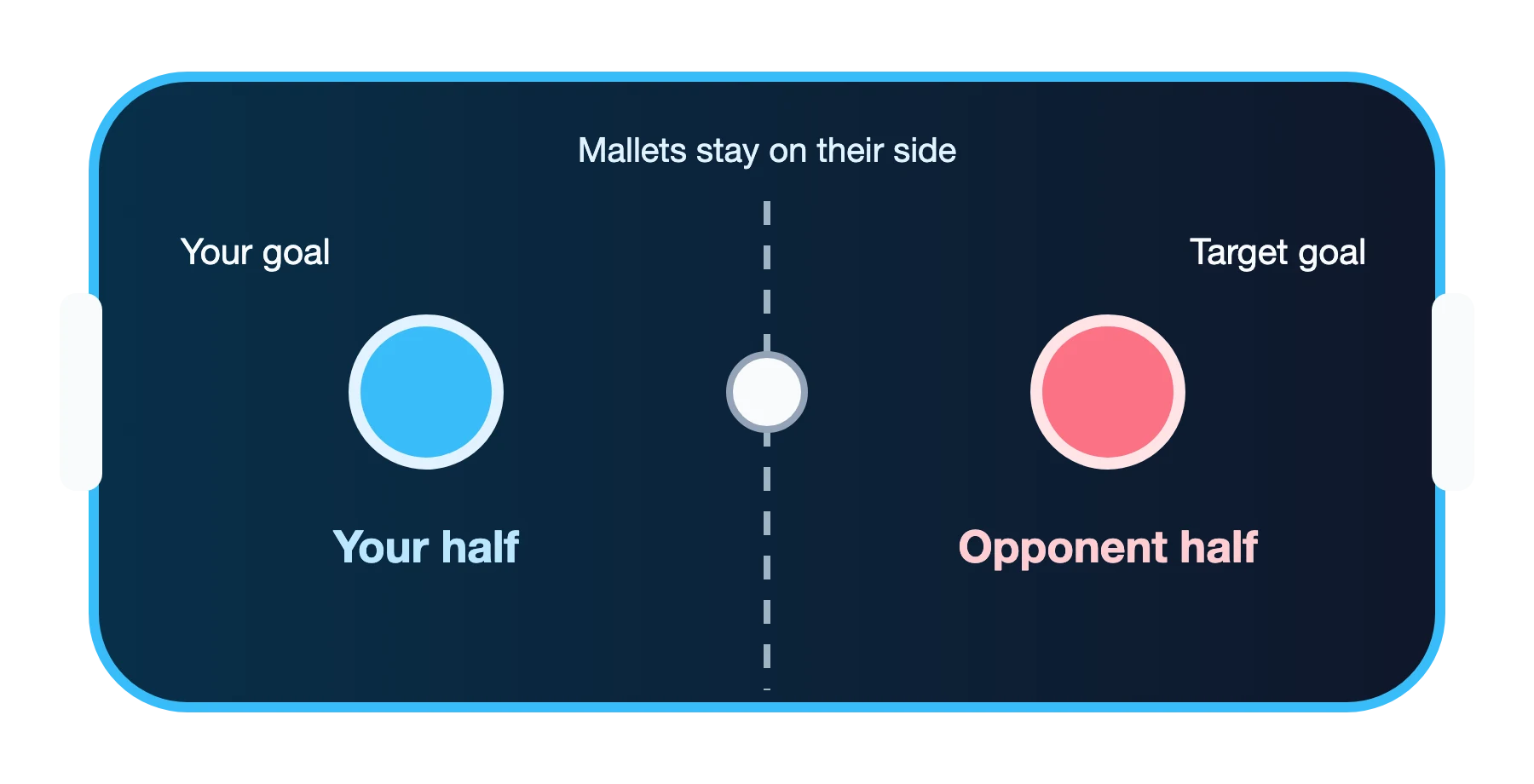
You defend the goal behind your mallet and attack the goal at the far end. The puck can travel the whole table, but your mallet stays on your own half.
The rules
- Each player controls one mallet and guards the goal behind it.
- Your mallet can't cross the centre line, even though the puck can.
- A goal scores one point when the puck goes through the opponent's goal opening.
- The rails are live. A puck that rebounds off a side wall and goes in still counts.
- After each goal, play pauses and the table resets for the next faceoff.
- There is no match clock. The game ends when one player reaches seven goals.
How a point plays out
A rally can get chaotic, but every point follows the same pattern.
- Defend Keep your mallet between the puck and your goal. A central position leaves room to react either way.
- Score Send the puck through the far opening. Straight shots and rail rebounds both count.
- Reset After a goal the table resets and the next faceoff begins. Get back to the middle.
Where to go next
Once the boundaries feel natural, the next step is positioning and angles. The strategy guide covers positioning, and bank shots covers using the rails. A short solo match against the AI is the quickest way to get a feel for the centre line, rebounds and the reset.
Common rules questions
Can I chase the puck across the centre line?
No. Your mallet stays on your half. Read the rebound early and prepare your next contact before the puck crosses away from you.
Does a rail rebound still count as a goal?
Yes. The rails are part of the live table, and a banked puck that enters the goal scores normally.
Does the game end at six goals?
No. Six goals is match point. The game ends only when a player reaches seven.
Should I stay where I finished my last shot?
Usually not. Recover towards the middle so the return shot doesn't find an empty goal.
You know the rules. Grab a mallet.
Play a friend in a private two-player room with optional video chat, or practise solo against the AI. No download, no sign-up.
Keep reading
Spotted a mistake or have a question? Send feedback