How to play Connect 4: a visual guide
Drop discs into a seven-column grid, block your opponent's lines and connect four of your own first. This guide covers the board, a turn, every way to win and when the game is a draw.
The board and the discs
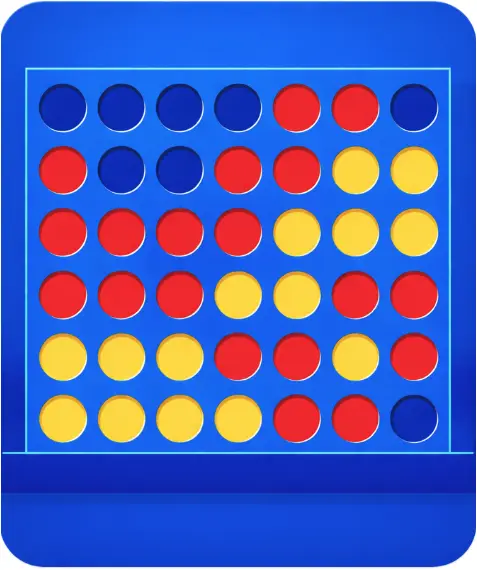
Connect 4 is a game for two players on an upright grid of seven columns and six rows, 42 slots in all. One player drops yellow discs and the other drops red. The board starts empty, so the first few turns shape the whole game, and each player places at most 21 discs.
When you play Connect 4 online, you pick a column on screen and your disc falls into it. Nothing floats, so every disc sits on the floor of the grid or on top of another disc.
Taking turns
Yellow moves first. On PlayFaceToFace the player in the first seat plays yellow and the other player plays red. After that the two players alternate, one disc per turn.
- Pick a column Choose any of the seven columns that still has an empty slot.
- Drop one disc Gravity places it in the lowest open slot of that column. You can't choose a slot higher up or leave a gap underneath.
- Pass the turn Your opponent then drops a disc, and play goes back and forth until someone connects four or the grid is full.
A disc stays where it lands for the rest of the game. Online, the board won't accept a drop into a full column or a move out of turn.
How to win
The first player to get four of their own discs touching in a straight line wins, and the game ends on that drop. The line can run in any of four directions.
- Across a row. The easiest line to see, especially along the bottom row.
- Up a column. Four discs stacked in one column, which punishes an opponent who lets you build there.
- Along a diagonal rising to the right.
- Along a diagonal rising to the left.
Diagonal wins are the easiest to miss. Each disc in a diagonal needs other discs underneath to hold it up, so the line is usually built one supported step at a time while both players fill the columns below it.
When the game is a draw
If all 42 slots fill up and nobody has connected four, the game ends in a draw. Close games between careful players often run deep into the board, so keep checking for lines until the last slot is gone.
Threats and blocking
The tactical heart of Connect 4 is spotting lines before they finish. Three of your discs in a line with an open fourth slot is a threat. If your opponent doesn't cover that slot, your next drop wins.
A slot is playable when the column is filled up to just below it. A three in a row whose fourth slot still has empty space underneath can't be finished yet. It becomes a real threat as soon as someone fills the column below, so think twice before you drop the disc that lets your opponent in.
A turn, in order
Every turn is simple, but each drop changes what both players can threaten next. This is the rhythm to remember.
- Scan for a win If you can complete four in a row, drop there now.
- Block the opponent Never leave your opponent a three in a row with a playable fourth slot.
- Choose a column that isn't full Your disc lands on the lowest empty slot in that column.
- Check all four directions After the drop, look across, up and along both diagonals for four connected discs.
Legal and illegal moves
Most mistakes in a first game come from forgetting that gravity decides where a disc goes.
Allowed
- Dropping into any column with space, so the disc takes the lowest open slot.
- Stacking on top of discs already in the same column, yours or your opponent's.
- Connecting four diagonally when every disc in the line has support below it.
Not allowed
- Placing a disc in midair. Gravity always pulls it down to the lowest open slot.
- Dropping into a full column. It has no open slot, so pick another column.
- Moving or removing a disc after it has landed.
Simple tips for your first games
The centre column sits in more possible lines of four than any other column, so discs there tend to do more work than discs at the edges. Building from the middle gives you more ways to connect later.
Before every drop, ask what the slot directly above your disc does for your opponent. Filling a column can hand them the support they need to finish a row or a diagonal.
Try a quick demo game
A live solo board against the AI, right here on the page. Drop discs, set up threats and connect four before the AI blocks you.
Connect Four

You know the rules. Drop the first disc.
Private rooms with friends and optional video chat, a quick public match, or a practice game against the AI. No download, no sign-up.