How to play checkers
Checkers takes minutes to learn and rewards planning for a long time after. This guide walks through American checkers (English draughts) from the first move to the last, with live boards for the moves that matter.
The board and setup
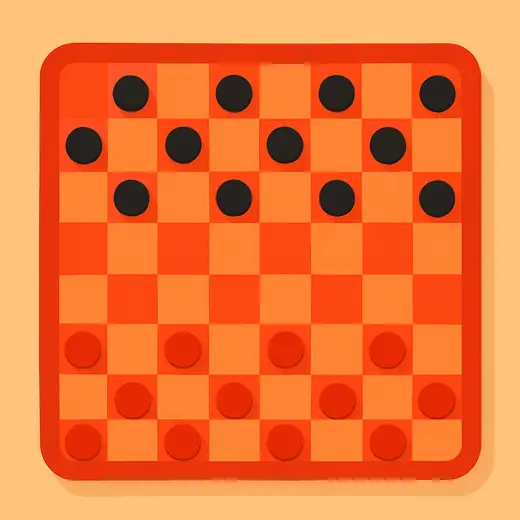
Checkers is played on an 8×8 board, and only the dark squares are ever used. Each player starts with 12 pieces on the dark squares of the three rows nearest to them.
The player at the top has the dark pieces, usually black, and the player at the bottom has the light ones, usually red or white. On our board the black pieces are drawn in blue. Black moves first, and each turn is a single move.
How the pieces move
Until it becomes a king, a piece (called a man) moves one square diagonally forward. That limit shapes the early game. You can't rush across the board, so every step is a commitment.
- Never sideways, straight forward or straight back.
- Never backward until the piece is a king.
- Never onto a light square. Only the dark squares are used all game.
On each turn you make one diagonal step forward or a jump. If a jump is available, you have to take it.
Captures are forced
Capturing is what gives checkers its tension, and it isn't optional. If you can capture one of your opponent's pieces, you must. A capture works like this:
- An opponent's piece sits diagonally next to yours.
- The square directly behind it, on the same diagonal, is empty.
- Your piece jumps over the opponent's piece and lands on that empty square.
- The jumped piece comes off the board.
If your piece can jump again after a capture, it must keep going in the same turn. Chains of two, three or more jumps happen, and they are the main reason checkers rewards close observation.
Making a king
When a man reaches the far row, on the opponent's side, it becomes a king.
- A king moves diagonally forward and backward, one square at a time.
- A king can capture forward or backward.
- Kings get around the board far more freely than men.
- One king can often outmanoeuvre two or even three men.
The full checkers rules show a king moving backward, forced captures with several options, and the exact timing of promotion.
Winning the game
You win by capturing all of your opponent's pieces, or by blocking their pieces so they have no legal move. Over a real board, players can also agree to a draw, which is common in competitive play.
Beginner concepts that win games
Control the centre. The four central dark squares matter more than any others. Holding them gives you more mobility, more chances to jump and sturdier defensive shapes.
Keep your pieces together. Pieces that split up early are easy to pick off. A connected formation blocks easy captures, backs up counterattacks and lets your pieces move as a group.
Don't race for a king. New players often push pieces forward too fast. Lone runners get captured, gaps open in the back rows, and the opponent finds room for multi-jumps.
Aim for a balanced, flexible position and avoid jams where your own pieces block each other. If you can't say why you are moving a piece, don't move it. The beginner strategy guide goes further.
Common beginner mistakes
- Moving the back-row defenders early, which hands the opponent easy kings.
- Playing on one side of the board only, which leaves the other side uncovered and weak.
- Ignoring threats that are a few moves away, so you miss multi-jumps for you or against you.
- Chasing kings too soon and wasting moves that should improve your structure.
- Pushing one piece at a time until it is isolated and lost.
Each of these is covered with examples in common checkers mistakes.
Try a quick demo game
A private solo board against the AI, right here on the page. Nothing to sign up for.
Checkers

You know the moves. Sit down at a board.
Private rooms with friends and optional video chat, or a practice game against the AI. No download, no sign-up.
Keep reading
Spotted a mistake or have a question? Send feedback