Chinese Checkers rules: how to move, jump and win
The rules of Chinese Checkers as played on PlayFaceToFace: the star board, steps, jumps, jump chains, what is not allowed and how to win.
Chinese Checkers is a race with no captures. Move all ten of your pieces from your starting triangle into the triangle directly opposite before anyone else does.
The board and the goal
The board is a six-pointed star of holes on a triangular grid. Each player starts with ten pieces in one point of the star, and their target is the point directly opposite. Our game seats two, three, four or six players.
- On your turn, move one piece by one step or by a jump sequence.
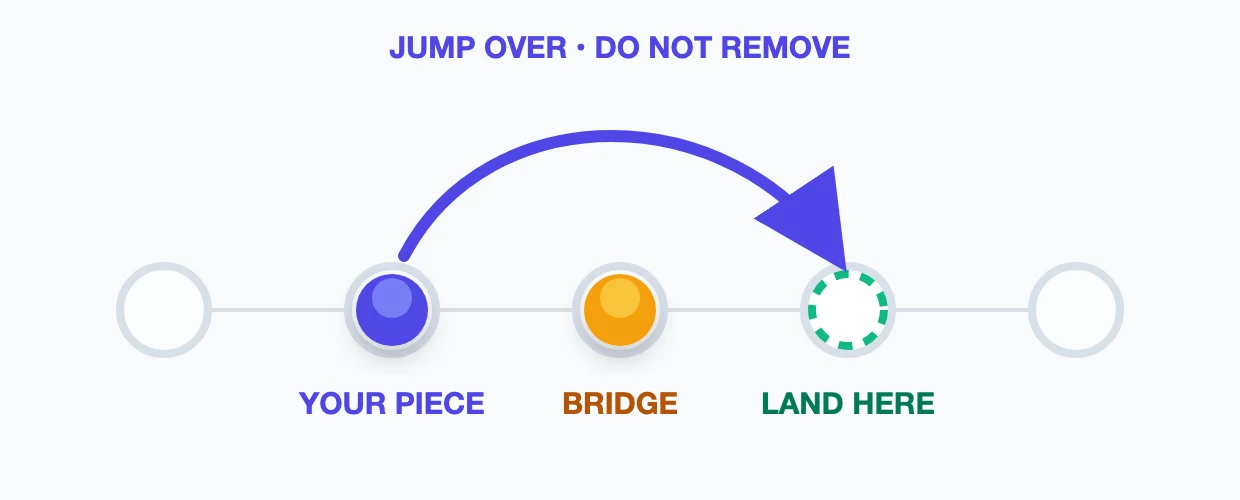
- A jump crosses one occupied neighbouring hole and lands in the empty hole just beyond it.
- You may chain several jumps with the same piece in one turn.
- Pieces are never captured or removed.
- The first player with all ten pieces in the opposite triangle wins.
A normal step
A step moves one piece into a neighbouring empty hole. Because the grid is triangular, a piece can step in any of six directions.
You can't step into an occupied hole. That piece may be something you can jump over instead.
Jumping
To jump, a neighbouring hole must hold a piece and the hole straight beyond it, on the same line, must be empty. The piece in the middle can be yours or anyone else's. You hop over it and it stays where it is.
Jump chains
After a jump, if the same piece has another legal jump from where it landed, you can keep going. A good chain can carry one piece across much of the board in a single turn. You can stop whenever you like, and a chain can't land on a hole the piece already visited that turn. Full details are in jumping rules and jump chains.
Chains decide most games. Strong players look past what one piece can jump right now and arrange their pieces so useful routes exist on later turns.
Jumping other players' pieces
Any piece can be the bridge for a jump. Unlike regular Checkers, jumping captures nothing, so opponents become useful stepping stones as the middle of the board fills up.
Moves that are not allowed
- Landing on an occupied hole.
- Jumping over an empty hole.
- Jumping when the hole beyond the crossed piece is occupied.
- Moving more than one piece in the same turn.
- Removing a piece after jumping it.
How to win
You win when all ten of your pieces stand in your target triangle, the point of the star opposite where you began. Every piece has to finish, so one piece stranded at the back can cost more time than a fast front runner gains.
How it differs from Checkers
| Rule | Chinese Checkers | Checkers |
|---|---|---|
| Aim | Race all your pieces across the board | Capture or block every opposing piece |
| Jumps | Never capture | Capture the jumped piece |
| Board | Star-shaped triangular grid | Square 8×8 board |
| Players | 2, 3, 4 or 6 | 2 |
Try a quick demo game
A private solo board against the AI, right here on the page. Nothing to sign up for.
Chinese Checkers

You know the rules. Start the race.
Private rooms for two, three, four or six players with optional video chat, or a practice game against the AI. No download, no sign-up.

Keep reading
Spotted a mistake or have a question? Send feedback