Chinese Checkers jumping rules: single jumps and jump chains
Everything about jumping in Chinese Checkers: the jump rule, jumping your own and other players' pieces, chains, and what makes a jump illegal.
Jumps are what make Chinese Checkers fast. You can jump over any neighbouring piece into the empty hole just beyond it, then keep jumping with the same piece while another landing is open.
The jump rule
A piece must sit in the hole next to yours, and the hole directly beyond it, on the same line, must be empty.
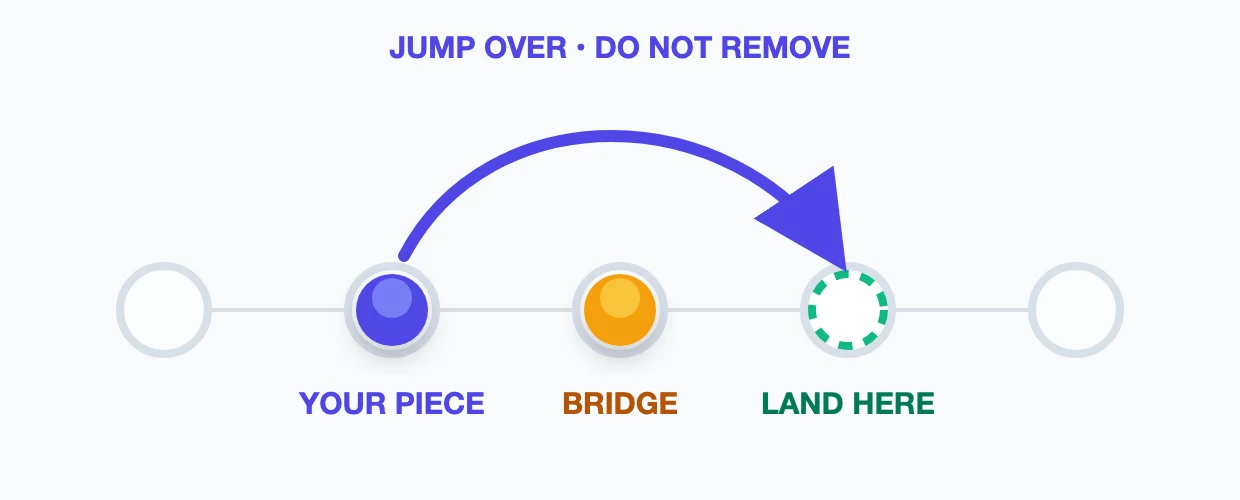
A single jump
Pick one of your pieces. If a neighbouring hole is occupied and the hole beyond that piece is empty, you may hop over it and land in the empty hole. The jumped piece stays on the board. Chinese Checkers has no captures, so a jump only moves your piece.
Whose pieces you can jump
Your own pieces make good bridges. A common opening idea is to place pieces so the ones behind can use them to launch towards the centre.
The middle piece can also belong to any opponent. That makes crowded positions surprisingly mobile, since an opponent may hand you the exact bridge you need.
Jump chains
After landing, check the six directions from the new hole. If another occupied neighbour has an empty hole beyond it, the same piece can jump again. A step only moves one hole, while a good chain can move one piece many times farther in the same turn.
Each jump is judged from the new landing hole, so a chain can change direction and zig-zag through the centre. You can stop the chain whenever you like. In our game a chain can't land on a hole the piece has already visited that turn, including the one it started from.
Steps and jumps don't mix
A turn is either one step or a sequence of jumps. If you step, your move is over. Chaining only applies to jumps with the same piece, and you can't switch to a different piece partway through.
What makes a jump illegal
- The hole you want to jump over is empty.
- The landing hole beyond the jumped piece is occupied.
- The landing hole isn't on the same line as the crossed piece.
- You try to remove the piece you jumped.
- You switch to a different piece in the middle of a chain.
Spotting long chains
Look two or three jumps ahead instead of judging only the first landing. The best first jump is often the one that opens a second and third landing through the middle, even when another jump travels farther at once.
- Use pieces near the centre as bridges you can reuse.
- Keep enough space between pieces so landing holes stay empty.
- Count opponents' pieces as possible links in your route.
- Move rear pieces early so they aren't stranded once the board clears.
Try a quick demo game
A private solo board against the AI, right here on the page. Nothing to sign up for.
Chinese Checkers

Try a jump chain on a real board.
Private rooms for two, three, four or six players with optional video chat, or a practice game against the AI. No download, no sign-up.

Keep reading
Spotted a mistake or have a question? Send feedback