What is checkers?
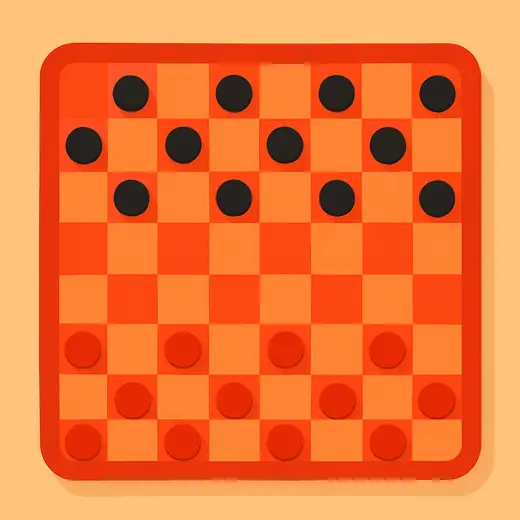
Checkers, also called draughts, is a strategy board game that has been played in Europe for centuries. Two players, 12 pieces each, an 8×8 board. You can learn it in a few minutes and keep finding new ideas in it for years.
Why checkers is easy to pick up
A new player can understand the rules in under five minutes. Playing well is another matter. It takes pattern recognition and the habit of looking several moves ahead.
There are no openings to memorise before you start and no zoo of piece types as in chess. Every piece starts the same, and the strategy grows out of two simple rules, diagonal movement and forced captures.
Games are quick, too. A typical match lasts 5 to 15 minutes, which suits a casual session or a run of rematches. Players often ask for the next game before the board has been reset, and the short games fit online play well.
The objective
You win by capturing all of your opponent's pieces, or by blocking them so they have no legal move left. Getting there means outmanoeuvring the other player, forcing trades that favour you, using mobility and position, and winning kings, the strongest pieces in the game.
How a typical game works
Checkers is played on the dark squares of an 8×8 board. Each player has 12 pieces, set out on the dark squares of the three rows nearest to them. Black moves first, and then the players take turns moving one piece at a time.
Most moves are single diagonal steps, but the game turns tactical once captures start. On a normal turn you might step a piece forward, answer a threat, set up a multi-jump, push a piece toward the far row to make a king, or hold a square that keeps your position together.
The rules that define checkers
Four mechanics give checkers its character. The full rules show each one on a live board.
- Diagonal movement. Ordinary pieces move diagonally forward, on dark squares only, which creates tension along the diagonals and room for traps.
- Forced captures. If you can jump an opponent's piece, you must. The rule drives the tactics and keeps the game moving.
- Multi-jumps. If your piece can jump again after a capture, it has to carry on. Good players build capture chains that drag the opponent into bad positions.
- Kings. A piece that reaches the far row becomes a king and can move backward as well as forward. Kings are more flexible and decide most endgames.
Where the strategy comes from
The more you play, the more layers you find.
Positional control comes first. Strong players hold the centre, keep their pieces spaced so they support each other, protect the key diagonals and avoid exposing pieces too early.
Then there is forcing play. Because captures are compulsory, you can lure an opponent into a jump that lands badly, set traps several moves deep, or give up a piece to gain time or a king.
Endgames reward precision. With only a few pieces left, every move counts. Kings dominate this stage, but two well-placed pieces can still win with the right technique. The beginner strategy guide is a good next step.
Try a quick demo game
A private solo board against the AI, right here on the page. Nothing to sign up for.
Checkers

You know the game. Sit down at a board.
Private rooms with friends and optional video chat, or a practice game against the AI. No download, no sign-up.
Keep reading
Spotted a mistake or have a question? Send feedback